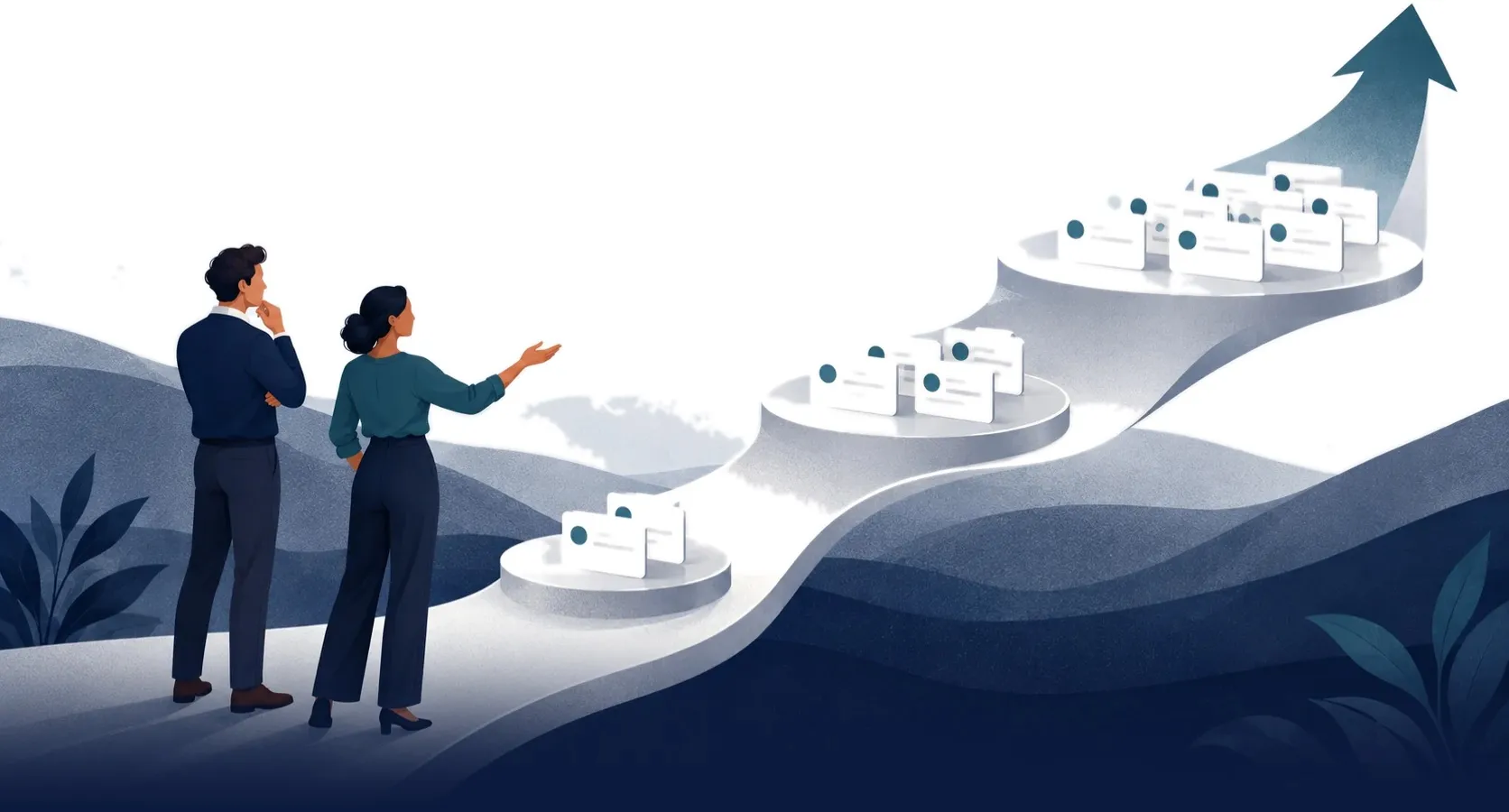
Most businesses we meet bought AI the same way. Licences for everyone, a message saying "have a go", and a hope that something useful happens.
Something usually does. People draft emails faster and summarise documents they'd otherwise skim. But the work itself runs exactly as it did before, and that's where the return was supposed to come from.
That's the myth ASCEND answers. AI adoption isn't a productivity perk you buy by the licence. Hand everyone a login and tell them to figure it out, and you've paid for a hundred private experiments and no change to how the business runs.
ASCEND is a simple scale for seeing where you really are, and what has to be true before you move up.
The six levels
The level names spell the framework.
- Accidental. "We don't really use AI here." They do: on their own free accounts, with nobody knowing what goes in.
- Supported. The business has chosen a tool, set rules and shown people how. AI sits beside the work. People copy information in and paste the answer out.
- Connected. AI can see the business: the CRM, the inbox, the accounts. A person still has to ask it each time.
- Embedded. The work runs by itself when something happens. People check it rather than do it.
- Native. Several areas run at Level 4 on one shared platform.
- Directive. AI spots work and starts it, within limits leadership has written down.
Levels 5 and 6 are the horizon. They're on the scale so you can see the direction of travel, and so nobody can sell them to you as the next step. For a business with 20 to 250 people, Level 4 is as far as it's worth going, and only in a few places.
A business is never at one level. Your sales can be Connected while your accounts are Accidental, so ASCEND looks at each area of the business on its own.
What has to be true before you move up
This is the heart of it. Each step up has a short list of things that must be true in how the business runs. Not roughly true: true, and something you could show someone.
From Accidental to Supported. Weeks, not months, and done once for the whole business.
- The business pays for one approved AI tool, and people use it instead of their own accounts.
- Everyone knows, in writing, what must never go into it.
- People have been shown how to use it well, and one named person owns AI.
From Supported to Connected. This is about information, not AI.
- AI is connected to a real business system, running live.
- The information it reads is accurate, and someone owns keeping it that way.
- The work is mapped step by step, as it really happens.
From Connected to Embedded. The hard one.
- The work starts by itself when something happens, not when someone remembers.
- You'd know before a customer did if it went wrong, and there's a tested plan B.
- Every run is recorded, and running it is part of a named person's job.
The full guide sets out every statement for every step, sorted into five pillars: tools, information, process, people and rules.
Red flags come first
Levels say what you've built. Red flags say whether it's safe to build on. A red flag doesn't change your level. It changes your next move: fix it before you climb. Five of the ten:
- Work goes into personal AI accounts.
- AI-written work reaches customers with nobody checking it.
- Nobody can list what AI is running in the business.
- An integration runs on someone's personal or admin login.
- Nobody knows how to switch it off.
Climb where the hours are
Not every area should climb. Put each one on two lines: how far AI has got there, and how many hours a month your team spends on repeated work in it.
- Climb here: lots of hours and a low level. This is where the return is.
- Level 2 is enough: few hours. Make it safe and stop.
- Protect it: lots of hours, already well covered. Keep the checks real.
- Over-built: few hours and a high level. More AI than the work justifies.
The honest target: Level 2 everywhere, and Level 4 for the two or three busiest tasks in the one or two areas carrying the most hours. Every level above what an area needs is cost and risk you've bought for nothing.
The wall at Level 4
Everything up to Level 3 adds something without asking anyone to work differently, which is why so much stops there. Level 4 takes a step away from how people work today, and three things are usually missing.
- A map. You can't hand a task to AI by default when nobody can say exactly how it runs today, exceptions and all.
- An owner. Redesigning the work is nobody's job, so it waits for the founder, who has no time.
- A safety net. Nobody would know if it went wrong, so a person checks every run, and that check is exactly what stops it being Level 4.
It's rarely a person refusing to change. It's three things nobody has had time to put in place. Process mapping provides the first and makes the other two easy to see.
An agent is not a level
Much of what's sold as an "AI agent" is a chat window with a few buttons. Ignore the label and ask four questions. Does the work start by itself? Is every run recorded? Would you know if it went wrong? Can it be switched off and undone?
An agent that passes is simply Level 4 done properly. One that doesn't is Level 2 with a bigger price.
Growth without hiring in step
At Level 4 your team stops doing the work and starts running it. The same people can take on far more, so the business keeps growing without adding a person for every step up. Nobody has to lose their job for that to be true. The hiring curve flattens, and people spend their time on the work that needs them.
What's your AI type?
Levels say how far AI has got. Types say how your people use it. Four opposites make 16 types, in the style of the Myers-Briggs:
| Question | One way | The other way |
|---|---|---|
| Who started it? | People-led | Business-led |
| Where does AI sit? | Assistant, beside the work | Engine, inside it |
| How fast does it move? | Fast | Steady |
| How is it checked? | Trust | Check |
The most common type is the Licence Buyer: business-led, AI as an assistant, fast, trusting. Everyone's got a login and nothing's changed. Others include the Mad Scientist, whose automations work and nobody knows how, and the Conductor, whose work plays itself while someone keeps time.
No type is better than another. Each has a superpower, a blind spot and a next move. Take the quiz to find yours, or see all 16 types. It takes about four minutes and tells you your level in the area that matters most to you.
When you want the real picture rather than a quiz, the free ASCEND assessment looks at the evidence with you, area by area, and tells you plainly where to climb and where to stop.